
Surrogacy can provide a family-building route when pregnancy is impossible, medically unsafe, or biologically unavailable to an intended parent. It may be considered by people with uterine-factor infertility, some cancer survivors, male same-sex couples, single intended fathers, and others after individualized medical and legal review.
Accurate information matters because surrogacy combines assisted reproductive technology, pregnancy care, contractual planning, mental-health support, expenses, and legal parenthood. Worldwide data remain limited: national fertility registries often count IVF cycles rather than complete surrogacy journeys, while private arrangements and traditional surrogacy may not appear in clinic data.
This guide explains what surrogacy means, how the process works, the latest verified surrogacy statistics, IVF vs surrogacy, costs, success factors, medical risks, and selected national laws. It also identifies the questions intended parents and prospective carriers should ask before treatment. It is educational information for general readers, not an assessment of any person’s medical or legal eligibility.
What Is Surrogacy?
Surrogacy is an arrangement in which a surrogate carries and gives birth to a child for the intended parent or parents. Many clinical and professional sources use gestational carrier when the person carrying the pregnancy did not provide the egg. Some communities still use “surrogate mother”; terminology preferences should be respected.
The main participants may include intended parents, a gestational carrier, an egg provider, a sperm provider, and a licensed fertility clinic. An agency may assist with matching and coordination where lawful. Each participant should have independent legal representation, and counselling should address consent, expectations, pregnancy decisions, privacy, and future contact.
Important distinction: Assisted reproductive technology (ART) is a category of medical procedures involving eggs or embryos. IVF is one ART method. Embryo transfer places an embryo into a uterus. A positive pregnancy test, clinical pregnancy, ongoing pregnancy, live-birth delivery, and live-born infant are different outcomes and must not be reported as if they were interchangeable.
Types of Surrogacy
Gestational surrogacy
An embryo is created through IVF using intended-parent or donor eggs and sperm, then transferred to a gestational carrier. The carrier provides the pregnancy but not the egg and is therefore not genetically related to the child.
Traditional surrogacy
The surrogate’s own egg is used, so the surrogate is genetically related to the child. Conception may use intrauterine insemination (IUI) or another insemination method and may not require IVF. Traditional surrogacy can involve additional consent, parentage, and emotional complexities and is restricted or unavailable in some jurisdictions.
| Feature | Gestational surrogacy | Traditional surrogacy |
| Genetic relationship | Carrier does not provide the egg | Surrogate provides the egg |
| Fertilisation method | IVF creates an embryo | Usually insemination/IUI; IVF may be used |
| Pregnancy carrier | Gestational carrier | Traditional surrogate |
| Legal complexity | Substantial and jurisdiction-specific | Often greater because the surrogate is genetic parent |
| Medical process | Embryo creation, uterine preparation, embryo transfer | Insemination or other agreed method |
| Availability | Most common clinic-based form | Restricted, uncommon, or prohibited in some places |
Surrogacy Statistics and Facts
The latest official surrogacy-specific HFEA data available when this article was reviewed in 2026 relate to UK treatments performed in 2022. These figures describe surrogacy patients and cycles recorded in licensed fertility treatment, not every UK arrangement.
- Surrogacy accounted for 0.4% of all UK IVF treatments in 2022.
- The number of recorded UK surrogacy patients rose from about 130 in 2012 to 230 in 2022—an increase of approximately 77% over ten years.
- Opposite-sex couples represented at least 39% of UK surrogacy cycles in 2022; 61% were grouped as “other family types.”
- The HFEA said most of the “other” group was likely male same-sex couples, but it also included small numbers of female same-sex couples and single intended parents; the data do not support an exact split.
- Average age at first IVF treatment was about 34 years for UK surrogates, compared with 35 years for IVF patients overall in 2022.
- About one-third of people who first gave birth as surrogates during 2011–2015 underwent another surrogacy treatment before 2022.
- The average multiple-birth rate among UK surrogacy patients fell from 14% in 2013–2017 to 5% in 2018–2022. Data for 2019–2022 were preliminary in the family-formations release.
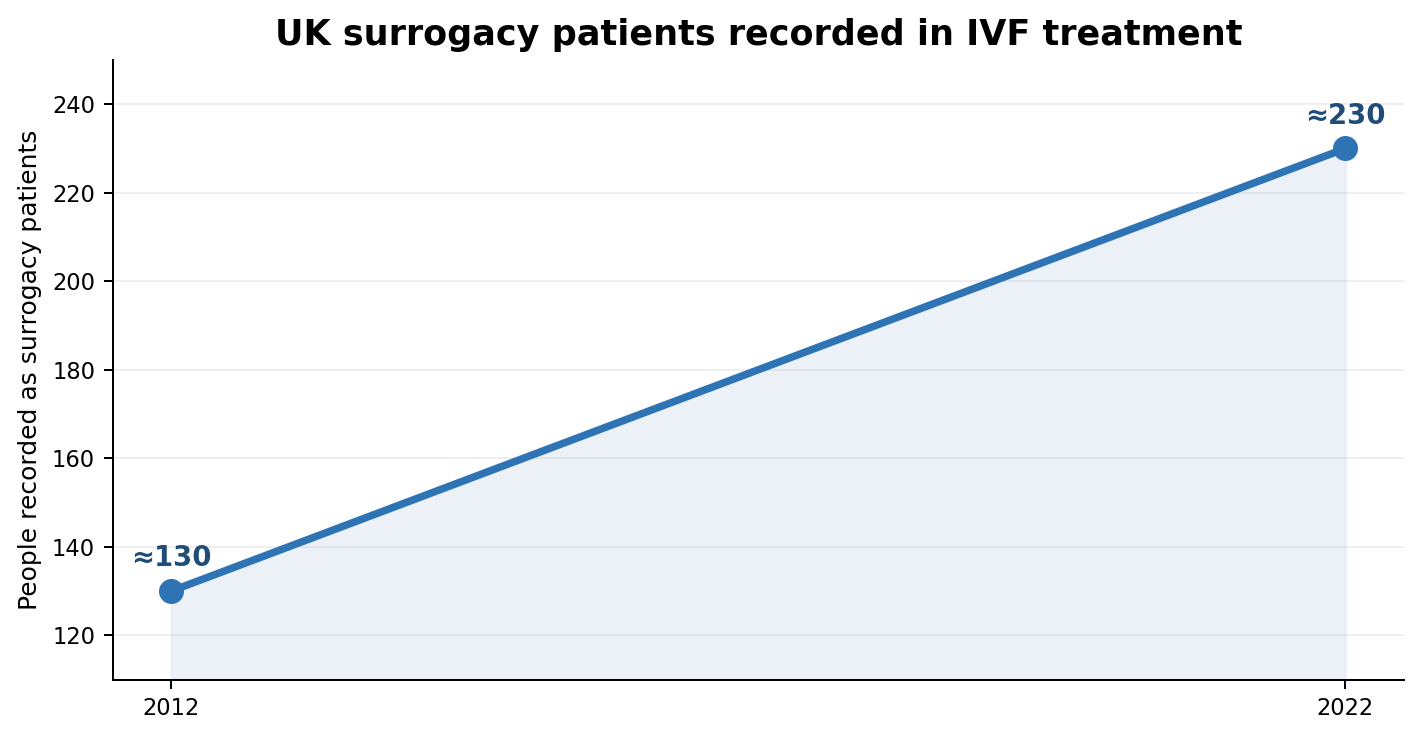
Growth in UK surrogacy patients.

UK surrogacy cycles by recorded family type, 2022.
Broader ART Context: Not Surrogacy-Only Data
CDC surveillance reported 435,426 ART cycles involving 251,542 unique patients at 457 US clinics in 2022. These resulted in 94,039 live-birth deliveries and 98,289 live-born infants, equal to about 2.6% of all US infants that year. The totals cover all reported ART, including egg or embryo banking, and must not be labelled as US surrogacy statistics.

US ART activity and outcomes, 2022.
Key takeaways
- Surrogacy is an arrangement in which a person carries a pregnancy for intended parent or parents; it is not itself a fertility treatment.
- IVF and surrogacy are not direct alternatives. IVF creates embryos outside the body; gestational surrogacy normally uses IVF so another person can carry the pregnancy.
- The latest UK surrogacy-specific regulator data available in 2026 concern 2022 treatment: surrogacy cycles were 0.4% of UK IVF treatments, and recorded patients rose from about 130 in 2012 to 230 in 2022.
- There is no universal surrogacy success rate. Live birth depends strongly on egg-provider age, embryo quality, sperm factors, carrier health, transfer policy, and clinic practice.
- Independent medical assessment, counselling, financial planning, and jurisdiction-specific legal advice are essential because parentage, eligibility, and payment rules differ widely.
IVF vs. Surrogacy: What Is the Difference?
IVF is a fertility treatment in which eggs and sperm are combined outside the body. Surrogacy is an arrangement in which another person carries a pregnancy for the intended parent or parents. Gestational surrogacy normally includes IVF.
| Question | IVF | Surrogacy |
| Definition | Medical process to create embryos | Pregnancy-carrying and parenthood arrangement |
| Main purpose | Assist fertilisation and embryo development | Enable another person to carry the pregnancy |
| Who carries? | Usually the IVF patient or partner | Surrogate or gestational carrier |
| Is IVF required? | It is the treatment itself | Usually for gestational; not always for traditional |
| Genetic relationship | Depends on egg and sperm sources | Carrier is unrelated in gestational; related in traditional |
| Medical procedures | Stimulation, retrieval, fertilisation, culture, transfer | Often IVF plus carrier preparation, transfer, and obstetric care |
| Suitable candidates | People needing fertilisation assistance who can safely carry | People unable or medically advised not to carry; some male couples/single men |
| Legal requirements | Consent and ART rules | ART rules plus contract, parentage, payment, and eligibility law |
| Financial complexity | Clinic, medicines, testing, storage | IVF plus screening, law, counselling, insurance, pregnancy and travel |
| Emotional considerations | Treatment uncertainty and loss | Those issues plus multi-party relationships and pregnancy boundaries |
| Major risks | Medication, retrieval, ectopic pregnancy, miscarriage, multiple birth | Transfer failure and pregnancy risks to carrier, plus legal and financial uncertainty |
| Success factors | Egg age/quality, sperm, embryo, diagnosis, laboratory | Those factors plus carrier health, uterus, transfer policy, obstetric care |
IVF or Surrogacy: Which Is More Suitable?
IVF may be more suitable when the intended patient can safely carry a pregnancy but needs help with fertilisation—for example because of tubal damage, male-factor infertility, a need for donor gametes or embryos, or unsuccessful lower-intensity treatment.
Gestational surrogacy may be considered when there is no uterus, a serious uterine abnormality, a documented condition making pregnancy dangerous, or cancer treatment has made pregnancy impossible or unsafe. It may also be relevant for a male same-sex couple or single man seeking a biological connection.
Recurrent pregnancy loss or repeated implantation failure requires specialist evaluation. Failed IVF does not automatically mean surrogacy is required; embryo, uterine, genetic, hormonal, laboratory, and other factors may need investigation.
- IVF may be appropriate when fertilisation assistance is needed and the intended parent can safely carry.
- Gestational surrogacy may be appropriate when carrying a pregnancy is impossible or medically unsafe.
- Medical suitability requires assessment by a reproductive-medicine specialist.
- Legal suitability requires independent advice from a lawyer familiar with each relevant jurisdiction.
Who May Consider Surrogacy?
Possible circumstances include congenital absence or surgical removal of the uterus, serious uterine abnormalities, medical contraindication to pregnancy, recurrent loss, repeated implantation failure after evaluation, and effects of cancer therapy. Some male same-sex couples, single intended fathers, and people with other documented reproductive needs may also consider it. Membership in a group does not itself establish eligibility under clinic policy or law.
Surrogacy Process: Step by Step
- Initial fertility consultation: define the family-building goal and whether surrogacy has a medical or biological indication.
- Assessment of intended parents: review health, fertility history, gamete sources, infectious-disease and genetic considerations.
- Carrier selection or matching: confirm that matching or agency activity is lawful in the relevant place.
- Medical screening: review the carrier’s general health, reproductive history, medicines, uterus, and infection testing.
- Psychological assessment and counselling: examine consent, support, expectations, pregnancy decisions, loss, and future contact.
- Independent legal advice: each side receives advice from separate qualified counsel.
- Surrogacy agreement: record lawful expectations on expenses, care, communication, privacy, insurance, and parentage.
- Egg and sperm plan: decide whether intended-parent or donor gametes and existing embryos will be used.
- IVF and embryo creation: retrieve eggs where needed, fertilise them, and culture embryos.
- Embryo testing if indicated: use only after medical and genetic counselling; testing does not guarantee a healthy birth.
- Carrier preparation: prepare the uterine lining and provide hormonal support when clinically required.
- Embryo transfer: transfer the agreed number of embryos; ASRM strongly recommends single-embryo transfer in carrier cycles.
- Pregnancy testing: measure pregnancy hormone after transfer; a positive result is not the same as a clinical pregnancy or live birth.
- Pregnancy monitoring: confirm location and viability, then continue appropriate prenatal and specialist care.
- Delivery: follow the carrier’s clinical needs, consent, hospital plan, and lawful information-sharing arrangements.
- Legal parenthood: complete the pre-birth, post-birth, parental-order, adoption, registration, or court process required locally.
The precise order differs by country, state or province, clinic, embryo source, and legal system. Treatment should not begin before required consents and legal clearances are complete.
Surrogacy Medical Screening and Eligibility
Screening protects the carrier, intended parents, gamete providers, pregnancy, and future child. ASRM’s 2022 guidance recommends a medical history and examination, infectious-disease testing, uterine-cavity evaluation, preconception counselling, psychosocial assessment, and legal counselling. Genetic contributors should also undergo applicable donor-style screening and testing.
- General physical health, reproductive records, and previous pregnancy outcomes
- A previous uncomplicated term pregnancy where professional guidance requires or recommends it
- Infectious-disease testing and medication, vaccine, substance-use, and lifestyle review
- Mental-health assessment, informed consent, independent counselling, and support systems
- Screening of egg and sperm providers and review of intended parents’ medical and psychosocial needs
ASRM prefers adult carriers aged 21–45 with prior uncomplicated pregnancy, but this is a named US professional recommendation—not a universal law. Clinic rules and statutes may use different age, birth-history, BMI, marital-status, nationality, or health criteria.
Surrogacy Success Rates
There is no single worldwide or national surrogacy success rate that applies to every case. Registries and clinics may report positive pregnancy per transfer, clinical pregnancy, ongoing pregnancy, live birth per transfer, cumulative live birth per egg retrieval, or singleton live birth. Different denominators and endpoints cannot be compared directly.
CDC success reporting distinguishes an intended retrieval, actual egg retrieval, embryo transfer, pregnancy, and live-birth delivery. A fair comparison must use the same outcome, patient group, egg source, treatment year, and follow-up period.
- Age, ovarian reserve, and health of the egg provider
- Egg and sperm quality and the underlying infertility diagnosis
- Embryo development, quality, and whether donor eggs are used
- Fresh or frozen transfer protocol and number of embryos transferred
- Gestational carrier’s uterine health and previous reproductive history
- Clinic laboratory, transfer, and follow-up practices
How to read a claim: Ask whether the rate means pregnancy or live birth, whether it is per transfer or per retrieval, whether cancelled cycles are included, and whether the result is specific to gestational-carrier cycles. A clinic figure must not be presented as a national or global rate.
Surrogacy Costs
Surrogacy costs vary substantially by country, payment law, insurance, medical needs, donor use, number of transfers, and travel. There is no reliable global average. A complete budget may include IVF, medicines, donor services, embryo storage, screening, counselling, independent lawyers, lawful matching services, insurance, prenatal and hospital care, travel, pregnancy expenses, permitted lost income, and post-birth parentage procedures.
For a transparent UK reference, the HFEA says one self-funded IVF cycle costs about £5,000 on average, with considerable variation and possible extra storage or consultation charges. Its surrogacy factsheet, citing Surrogacy UK, says reasonable expenses are typically £10,000–£15,000. These are separate components, not a total surrogacy price, and the expense figure depends on individual circumstances.
In the United States, Canada, India, Australia, and New Zealand, no single government figure provides a standardized national total covering all medical and legal components. Readers should request itemized written estimates, identify refundable and non-refundable charges, test insurance exclusions, model the cost of failed transfers or complications, and keep a contingency reserve consistent with local law.
Surrogacy Laws by Country
It is not a substitute for legal advice. Laws may differ within a country and may depend on residence, nationality, marital status, genetic connection, where treatment occurs, and where the child is born.
United States
In the United States, surrogacy law is governed primarily at the state level, as there is no single federal surrogacy code. Commercial compensation may be permitted in some states, while other states impose different restrictions. Eligibility requirements, legal procedures, and agreement rules vary depending on the state and type of surrogacy. Legal parenthood may be established through a pre-birth order, post-birth order, or operation of state law. Requirements relating to residency, independent legal counsel, contract formalities, and traditional surrogacy can also differ. Key legal references include California Family Code §§7960–7962, New York’s Child-Parent Security Act (CPSA), and Michigan Act 24 of 2024.
United Kingdom
In the United Kingdom, surrogacy arrangements are lawful, but surrogacy agreements are generally not legally enforceable. Commercial surrogacy is not permitted, although surrogates may receive reasonable pregnancy-related expenses, with payments subject to court review during the parental-order process. Couples and individuals may apply for a parental order if statutory requirements are satisfied, including applicable genetic-link requirements. The surrogate is considered the legal mother at birth, and legal parenthood is later transferred through a parental order. Important restrictions include rules on advertising, consent that cannot generally be given until at least six weeks after birth, and the requirement that parental-order applications are normally made within six months. Key sources include the GOV.UK surrogacy pathway and Human Fertilisation and Embryology Act 2008.
Canada
In Canada, altruistic surrogacy is permitted under federal law, while parentage and some procedural requirements are governed by individual provinces and territories. Federal law prohibits paying a surrogate for providing surrogacy services and also restricts payment for arranging surrogacy. However, eligible expenses may be reimbursed under regulated conditions. Federal rules also impose certain age-related restrictions concerning surrogacy-related counselling and procedures involving individuals under 21 years of age. Legal parenthood depends on provincial or territorial legislation. For example, British Columbia’s Family Law Act, section 29, provides a framework involving a written preconception agreement and post-birth consent. Reimbursements generally require documentation such as receipts or declarations, while some lost-income reimbursements require medical certification. Key sources include the Assisted Human Reproduction Act sections 6 and 12, SOR/2019-193, and British Columbia Family Law Act section 29.
India
In India, surrogacy is restricted to regulated gestational and altruistic arrangements. Commercial surrogacy is prohibited, although permitted medical expenses, prescribed costs, and insurance coverage for the surrogate may be provided. Eligibility is limited to specific statutory categories, including qualifying married Indian couples and certain Indian widows or divorcees, subject to medical, age, and other legal criteria. A court order concerning parentage and custody is required, and a child born through an approved surrogacy arrangement is legally treated as the biological child of the eligible intended parent or parents. Major restrictions include surrogate eligibility requirements, a one-lifetime-surrogacy limit for the surrogate, use of registered clinics, prescribed insurance coverage of 36 months, and conditions relating to donor gametes. The principal legal framework is the Surrogacy (Regulation) Act, 2021 and applicable Rules and amendments through 2026. Reviewed 13 August 2026.
Australia
In Australia, altruistic surrogacy is permitted across all states and territories, although individual jurisdictions apply their own eligibility, counselling, legal, and procedural requirements. Commercial surrogacy is prohibited, while reasonable surrogacy-related expenses may generally be reimbursed according to local legislation. Intended parents normally need to obtain a parentage order from the relevant state or territory authority or court after the child’s birth. Rules differ regarding eligibility, counselling, independent legal advice, advertising, and reimbursement. Some jurisdictions also impose restrictions relating to residents entering into commercial surrogacy arrangements overseas. Key references include the Australian Government’s official surrogacy information and state or territory legislation such as the New South Wales Surrogacy Act 2010.
New Zealand
In New Zealand, entering into a surrogacy arrangement is not itself illegal, but surrogacy agreements are currently unenforceable. Surrogacy is generally altruistic, and payments beyond permitted reasonable expenses are prohibited. Clinic-assisted gestational surrogacy arrangements may require relevant ethical and clinical approval before treatment proceeds. Under the current legal framework, intended parents generally need to use the adoption process to obtain legal parenthood following the child’s birth. New Zealand has considered reforms to modernize its surrogacy laws, but the referenced reform bill had not completed the legislative process or received assent according to its official status as of the review date. Important sources include the Human Assisted Reproductive Technology Act 2004, Adoption Act 1955, and the relevant surrogacy reform bill status.
Benefits of Surrogacy
Potential benefits include a family-building option when pregnancy is impossible or unsafe, the possibility of a genetic connection, access for some same-sex couples and single intended parents, use of stored gametes or embryos, and structured monitoring in clinic-based gestational arrangements. These benefits depend on medical feasibility and lawful access.
Medical and Pregnancy Risks
Gestational surrogacy is not risk-free. The carrier may experience medication effects, ectopic pregnancy, miscarriage, multiple pregnancy, gestational diabetes, hypertension or pre-eclampsia, caesarean birth, infection, postpartum haemorrhage, and emotional stress. Risk depends on personal health, embryo number and source, pregnancy history, and obstetric care.
A 2024 Annals of Internal Medicine cohort study of 863,017 singleton births in Ontario (2012–2021) included 806 gestational-carrier births. Severe maternal morbidity occurred in 7.8% of gestational-carrier pregnancies, compared with 4.3% after IVF and 2.3% after unassisted conception. This observational result may reflect residual differences between groups and is not an individual risk prediction, but it supports careful counselling and monitoring.
Intended parents may face failed transfer, pregnancy loss, unexpected treatment or hospital costs, legal uncertainty, disagreement during pregnancy, and cross-border citizenship or parentage problems. The carrier retains bodily autonomy and makes clinical decisions about their own care under applicable law.

UK multiple-birth rates among surrogacy patients.
Psychological and Ethical Considerations
Ethical practice requires informed and voluntary consent, protection from coercion or exploitation, independent legal representation, psychological counselling, privacy safeguards, and respect for the carrier’s autonomy. Participants should discuss prenatal testing, termination, multifetal reduction, delivery, communication, social media, expenses, future contact, and disclosure to the child before treatment.
Cross-border arrangements can magnify inequality, access barriers, citizenship uncertainty, data gaps, and differences in rights based on marital status, sex, sexual orientation, or nationality. A balanced plan should consider the welfare and identity rights of the child, the carrier and family, gamete providers, and intended parents.
Questions to Ask a Fertility Clinic or Surrogacy Professional
- Is the clinic licensed, and who regulates its laboratory and carrier cycles?
- How are carriers, intended parents, and gamete providers medically and psychologically screened?
- How does the clinic define pregnancy, clinical pregnancy, live birth, and cumulative success?
- What is the single-embryo-transfer policy and approach to multiple-pregnancy prevention?
- Which costs, medicines, storage, cancellations, complications, and legal steps are excluded from the quote?
- What insurance review, emergency plan, data-privacy process, legal coordination, and complaint route apply?
Frequently Asked Questions
What is surrogacy?
Surrogacy is an arrangement in which one person carries a pregnancy for intended parent or parents. It may be gestational, where the carrier provides no egg, or traditional, where the surrogate’s egg is used. Medical and legal rules depend on the location and arrangement.
What is gestational surrogacy?
Gestational surrogacy uses an embryo created through IVF. The embryo may use intended-parent or donor eggs and sperm. Because the gestational carrier does not provide the egg, the carrier is not genetically related to the child. Screening, counselling, legal planning, and embryo transfer are normally part of the process.
What is traditional surrogacy?
Traditional surrogacy uses the surrogate’s own egg, commonly with insemination or IUI. The surrogate is therefore genetically related to the child. This can create additional consent and parentage issues, and the arrangement is restricted or unavailable in some jurisdictions. Independent legal advice is especially important before conception.
What is the difference between IVF and surrogacy?
IVF is a medical treatment that combines eggs and sperm outside the body and may produce embryos for transfer. Surrogacy is an arrangement for another person to carry a pregnancy. Gestational surrogacy normally uses IVF; ordinary IVF does not necessarily involve a surrogate.
Is IVF better than surrogacy?
Neither is universally better because they solve different problems. IVF may suit someone who needs fertilisation assistance and can carry safely. Gestational surrogacy may be considered when carrying is impossible or medically unsafe. A specialist and independent lawyer should assess the relevant facts.
Does surrogacy always require IVF?
No. Gestational surrogacy requires IVF because an embryo created outside the body is transferred to the carrier. Traditional surrogacy may use IUI or another insemination method. Whether traditional surrogacy is lawful or available depends on the jurisdiction, and clinic practice may impose additional requirements.
Is a gestational carrier genetically related to the baby?
No. A gestational carrier does not provide the egg. Genetic links come from the egg and sperm providers, who may be intended parents or donors. This differs from traditional surrogacy, where the surrogate provides the egg and therefore has a genetic relationship to the child.
What factors influence surrogacy success?
Important factors include egg-provider age, ovarian reserve, sperm and embryo quality, donor use, infertility diagnosis, fresh or frozen transfer, embryo number, carrier uterine health and pregnancy history, and clinic laboratory and transfer practices. Success must be defined by a specific outcome, and no outcome is guaranteed.
How much does surrogacy cost?
There is no reliable global average. Costs can include IVF, medicines, donors, storage, screening, counselling, lawyers, lawful matching services, insurance, prenatal care, delivery, travel, expenses and parentage procedures. Request a jurisdiction-specific, itemized budget and contingency plan that addresses failed transfers and medical complications.
Is surrogacy legal in every country?
No. Some countries permit only altruistic arrangements, some regulate compensated gestational surrogacy, and others prohibit or do not recognize arrangements. Rules may also differ by state, province, or territory. Legal advice is needed before treatment or cross-border travel because parentage and citizenship may be affected.
What medical screening does a surrogate undergo?
Screening commonly covers medical and pregnancy history, physical examination, uterus, medicines, infection testing, lifestyle and substance use, mental health, support, and informed consent. Egg and sperm providers are also screened. Exact requirements follow local law, clinic policy, and professional guidance.
Can a single person or same-sex couple use surrogacy?
Access depends on law and clinic policy. Some jurisdictions permit eligible single intended parents and same-sex couples; others restrict access by marital status, sex, nationality, genetic link, or medical indication. Eligibility should be checked in every place connected to the arrangement.
How long does the surrogacy process take?
There is no fixed timeline. Matching, screening, counselling, legal work, IVF, embryo transfer, repeat attempts, pregnancy, birth, and parentage procedures can each add time. The process may take well over a year, especially if matching or transfer is delayed. Local legal steps can also extend the schedule.
What are the principal risks of surrogacy?
Risks include medication effects, failed transfer, ectopic pregnancy, miscarriage, multiple pregnancy, hypertension, diabetes, caesarean delivery, haemorrhage, infection, emotional distress, legal uncertainty, financial pressure, and cross-border parentage problems. Risk levels differ between people and pregnancies, so individualized medical and legal evaluation is necessary.
Conclusion
Surrogacy is a complex family-building pathway combining fertility medicine, pregnancy care, relationships, finance, and law. IVF and surrogacy have different functions but are frequently used together; neither is universally better. Medical suitability, costs, eligibility, and legal parenthood depend on individual circumstances and location. Independent medical, psychological, financial, and legal guidance is essential before proceeding.
Medical and legal disclaimer: Surrogacy laws, eligibility requirements, medical practices, and parentage procedures vary by jurisdiction and may change. This article provides general educational information and does not constitute medical or legal advice. Intended parents and prospective surrogates should consult qualified fertility specialists and independent legal professionals.

Jeff Berman is a healthcare and medical technology journalist with over 7 years of experience covering the global medtech, biotechnology, pharmaceutical, and healthcare sectors. As a contributor to Just MedTech, he specializes in industry news, market trends, regulatory developments, mergers and acquisitions, and emerging innovations shaping the future of healthcare worldwide. Contact: jeff.b@justmedtech.com.